Design Practice II
Masters
Week 7 - What is a proof of concept project?
addressing project needs and initial ideations

Peer Catchup
The first week of Design Practice 2 (DP2) we began with a discussion with our peers of our most reecent practs, drawing from our work in Design Practice 1 (DP1) and what we will focus our practice towards through this paper. It has been introduced to us that our deliverables for DP2 will be a proof of concept, positioning our practice an through an artefact that communicates our research findings and design opportunities as evidence of our position moving into our thesis in semester 2. Through discussion with my peers, Sophia, Floyd and Ben, who all have varying design opportunities and who come from different disciplines i was able to gain a perspecitive ond look at opportuniities to strengthen my practice from DP1, with opportunities to question the role of function in interior car design and exploring different means of experimentations to understand driver awareness and current user interaction (UI) design in modern interior car design.
Experimentations to understand how driver percieve the interior car space can be a method to look into further into my masters programme, looking at how drivers read the car and how language is communicated in that space. My peers suggested to look into using a combination of Heat Mapping and Eye tracking as an analysis of driver focus when driving. This form of exploration into the different user interactions and distractions while driving is not only an insightful opportunity to explore but can also lead to design opportunities, as it can lead to analysisng what does and doesnt work in current interfaces, and how that can be better designed. The difficulty comes with ethics and when trying to understand drivers and their current interactions, gaining insight form different users will only be possible later in my practice however this information is useful for myself to begin considering how i can take my making and begin applying it to real world contexts and simulating experiecences which in doing so can question the current and future roles of function within the interior car space.
As I look to integrate past interfaces and technologies with future technological advancements i am still considering at the role of driver and passenger needs, and how the current trends are shifting from a driver focused interior to being a passenger focused space. My peers also considered how my practice is taking on work from UI design. UI design is usually a digital medium but in context to my design opportunity it is transformed into looking at UI design as a physical medium, through an interface in how driver and passenger can connect to the space and to the vehicle. In doing so my practice can begin to question the need for Human Reliance while driving and how function with a technological integration can integrate the neeed for human interaction in automotives.
Lecturer Feedback (N/A) :
Because of the time it took to get to everyone and my need to leave after class I didnt have a chance to talk with my lecturers this week, I look to discuss through my making next week for a more critical feedback session.
Reflection on Practice
This week, my practice reflected a missed opportunity in DP1, looking at interactions and developing a deeper understanding of how functions and current interactions are seen in interior car design. My lack of exploration in DP1 was in relation in my need to explore and understand my position of my practice and an exploration into the contexts I want to be designing for.
Digital and Analogue Integration


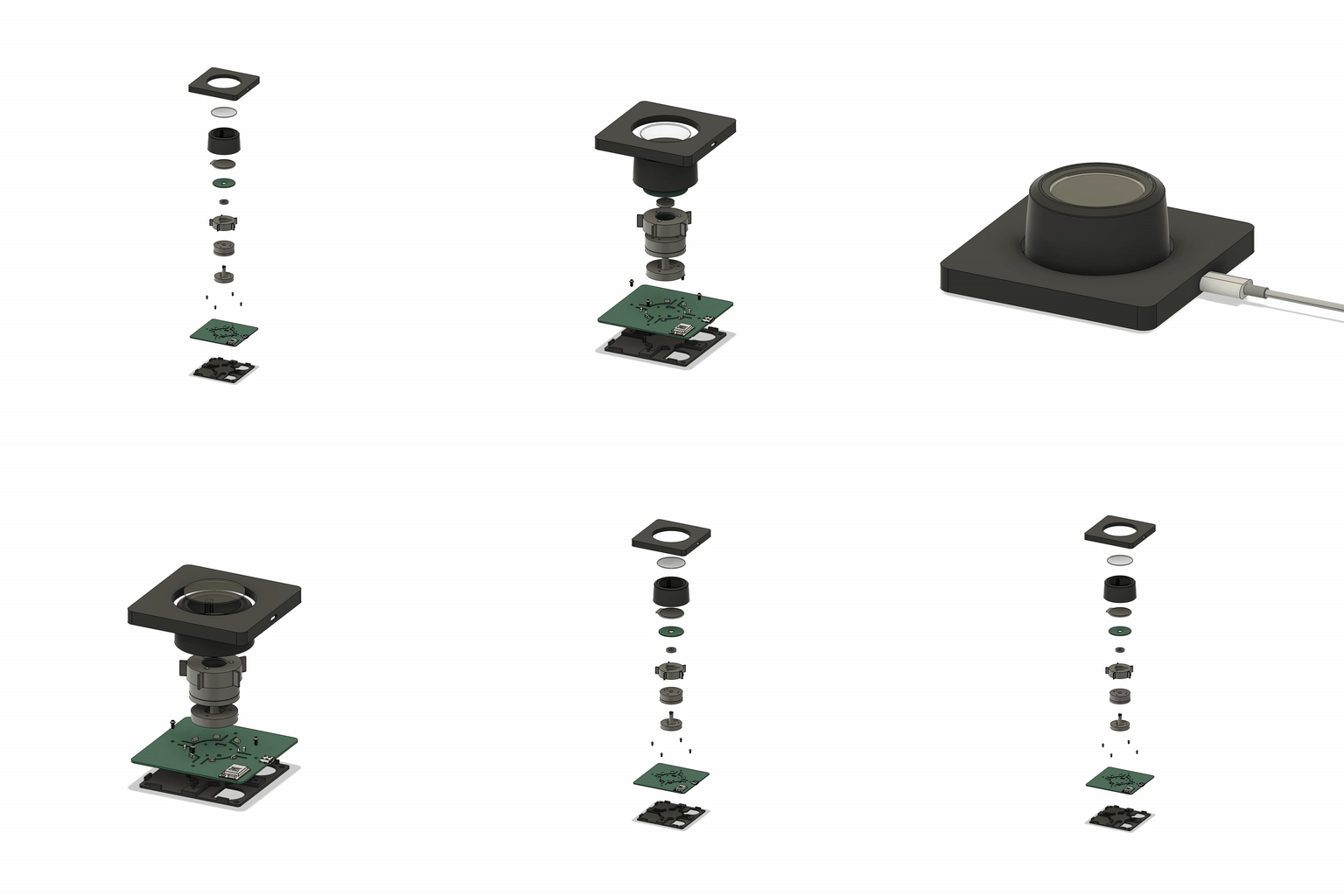
I began my exploration with an interesting concept i had found, seeing an integration between analogue and digital design through this dial called the “smartknob” that allows for control and functions in the home environment through a single haptic dial. This led me to exploring how this worked, how a combinaion of 3D modeling and electrical engineering can create a system that represents what i want my project to be. I explore with this curiosity as it is an open source project i looked deeper into how i could make my own, looking into the thinking of others and their opportunities into how they have been able to use this product. As i continued looking deeper and deeper into this “smartknob” project i realised i had gone too far, diving too fast into one idea that i hadnt considered its applications into my work and the need for it at this stage of my project. When talking to Joan (an AUT 3D labs technican) there was an insight to look smaller, not at creating a system or a product at this stage but to look smaller, into what makes an interaction satisfying, and intuitive to do. She encouraged me to look at different applications, not diving into a particular topic too quickly and expand my research to look at how other interactions communicate similar properties that i was seeking. Busy boards, sound boards, loking into switches, dials in different contexts to get to the root of my project, which is to understnad how humans interact with the world around them to get a response and how that response is engrained in us to create a more intuitive, intimate interactions through these relationships and how this influences our interactions with the world around us, aka. Affordances. Affordances, a key and fundamental property of Industrial Design, my discipline, was the key to my project and in understanding how affordance influences intuitive responses to envoke a greater sense of proprioception.

Making Practice This Week
My making this week looked into creating a functions, looking into mechanisms and how it can be translated into the context of a car. I drew from my practice in DP1 Week 1 and looked at fidgit toys as functions in a car. As I look to design for affordances and analogue interactions i need to understand the mechanisms and how to design for these well. Looking at a fidget ring i saw an opportunity to put it into the context of a dial, a common interaction seen in many cars.
Dial Modeling
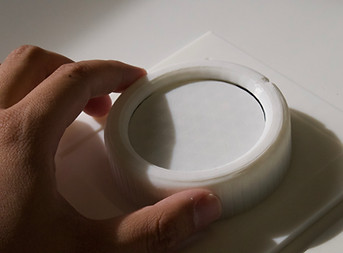
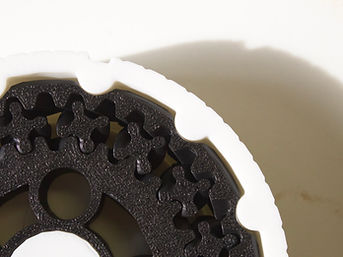
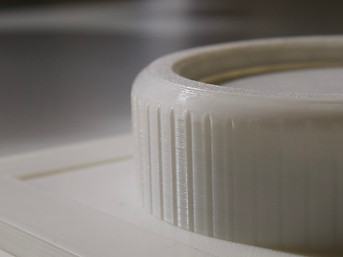
Something that came from my practice was viewing the quality of my making, as the inital design used functions from a fidget toy there were details that made the interaction less responsive and ‘cheap’. The many parts and gears used for the mechanism lacked a strong tolerance, making the dial shake and not as structually sound. As an interaction that will be used alot it needs to be steady and stable, my artefacts current design allows for the gaps in tolerances to create an unstable nature of the dial that affects its movement but also affecting sound and touch.

Communication through Quality
Another detail that will improve this interaction is how the object responses to being used. its current unstable nature and use of many gears causes the dial to both be loud and unsteady, communicating a weak interaction. Through a ‘click’ (sound or response) and a stable rotating movement, a clear message is being communicated to the user that a strong connected interaction is happening, through the confirmation of engagement. Being able to take this design, move forward and creating a convincing and strong response to the user, will allow haptics to be better comunicated and create a stronger engagement with the useer and the function.
Week 8 - Establishing an arc of inquiry
Gaining context and exploration of function and haptic feedback

Peer Catchup
The discussion with my peers (Sophia, Floyd and Galina) this week was a broad catch up on our practice over the week, discussion of our making and how others have been framing their practice to align with the research but also their understandings of how to achieve a proof of cooncept through everyones niches and design opportunities. Our discussions revolved around two key topics were of focus this week as the discussions centred around the use of AI as well as peers looking to understand their positioning before they begin making.
My peers also were taking their time to get into making for Design Practice 2, with alot of them creating a position or looking for certain design opportunity to begin defining their practice towards. When hearing how they are taking time to position their work it made me reflect on my practice from last week, as i had jumped straight into what i think i should do rather than reflecting on my previous practice and looking at what does my practice need to reflect for this paper. DP1 and DP2 though are both practice led papers the intention behind the making are different. DP1 looks at exploration through my hunch and defining my research through making, DP2 sould reflect my define focus, developing a proof of concept that proves that my research is and can be reflected in my thesis in semester 2. When reflecting on my practice i need to think smaller, look at how i can position my practice to reflcet my research better through haptics and driver interaction to promote a greater sense of proprioception in drivers through a more focused project.
AI is a tool that AUT has been both encouraging us to use as well as a tool we need to be mindful of interms of intellectual property and creaative identity, because of these reasons i have chosen to seperate my practice and research from my use of AI. Through discussion with my peers I see how they think, iterate and develop their ideas and concepts using AI not as a way to do their work but to put their concepts and thinking into the world, by using a faster and more iterative process. As i look forward into desigining for interactions and making small, subtle changes to my designs i may look at AI tools, such as Viscom, to generate my ideas to give my ideas a visual identity as i design.

Lecturer Feedback (Sue Gallager)
For the Design Practice 2 there may be a need to look at this paper not to add or start my masters thesis but rather as a 6 week ‘mini’ project. When working through Design Practice 1 the aim was to gain a position that we can focus our thesis around through rapid prototyping, exploring methods and seeing opportunities to design and deepen our research hunch to research question. Design Practice 2 should be a refinement of DP1 explorations, taking design opportunities and looking deeper into how these opportunities can show evidence that support our research question, stengthening our research and positioning our practice to reflect our research hunch and research done in contextual review and creative research practice.
Sue Gallanger encouraged me to look at DP2 as a six week project, not making for my thesis. Framing the paper in this way makes the scale of the project more achieveable. Even though this will be a proof of concept for my research question and will be the basis of my research moving into my thesis. At this current stage in DP2 Sue encouraged me to look smaller, designing for an interaction within the driving experience and critically designing for that function/interactions as my proof of concept for the next 6 weeks as an achieveable and tangible product that focuses on haptics, driver feedback that looks critically on mechanisms and analogue functions that can be explored in this space.
From this I will refine my practice into a specifc interaction, looking at how the design of steering wheels and how the driver interacts with its functions. Conducting a critical analysis on its core functions as well as design opportunities in this space, interactions that align with my research hunch into haptic feedback and intuitive design that aligns with driver proprioception.
Reflection on Practice
My practice this week looks to gain a deeper context to haptics and to look forward to creating a proof of concept for the summative in week 12. After my feedback from Sue and reminding myself that this is a six week project i look to focus my scope down to one interaction and being able to commuinicate haptic design through it. My focus for DP2 will be in designing the interaction between driver and car through the steering wheel as it is the most hands-on interaction for a driver with opportunity to understand and explore functions and haptic through it.
Design of Driver Seat Interior
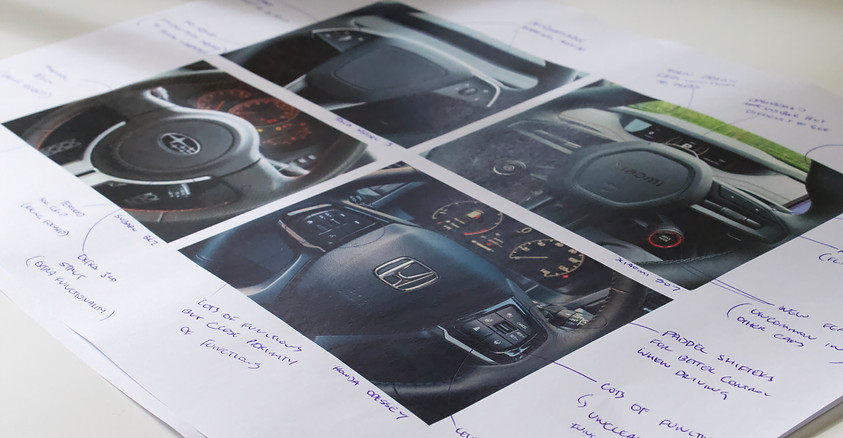
Through this focus I began by looking to do an audit of current environments of driver seating and interactions close to it in modern cars, exploring different contexts, philosophies and how i can critique and draw from these designs. I looked to explore the approach differnt manufacuteres have taken to designing the drivers space, loking at examples such as Tesla and Xiaomi to question their minimalistic approach and big integration of technology. Noticing that many basic functions such as control of cabin atmoshere, sound and maps are being controlled all digitally by a tablet, creating a harder to access but easier to engineer solution for manufacturers and a way to ‘clean-up’ the space by emilinating buttons and functions. However in different contexts such as with Subaru and Honda the focus shifts, opting for a more function heavy console relying on buttons and dials as an easier to use but harder to engineer solution, putting the prioritities of the manufacurer to the driver experience and having a control for each function.

Steering Wheel Audit

I further explored through an audit of the same cars but focusing on their steering solutions, looking at how do the manufacturers priorities translate from the interface design to the design of the steering wheel. Tesla and Xiaomi focuses on driver custimisation, opting for a simple layout and non-descriptive icons that need to be learned before being able to use instinctively without focusing consciously. This combined with dials that are also non-descriptive and not affordant that makes me question their ease of use. Honda’s focuses on giving many functions in an easy to reach vacinity, however it comes at the cost of overcrowding the steering wheel, placing buttons in close proximity to each other making it hard to use intuitively. Subaru takes a pure driving focused lens, having no buttons but rather a clean and simple approach to driving, with a focus on the drive and nothing more.
After my discussions with Sue there was a key relationship that i hadnt explored which would be beneficial for framing my context better that i am designing for which is the relationship between the driver with the drive itself. The experience of driving and how design can encompass and focus around this experience rather than it being of the experience of the entire interior, considering factors outside of the car and responding to that through haptic design. When reflecting on the spaces of modern car interiors how much of them are focusing on the experience of the drive, the reliance on features and functions all distract from the experience of driving and the relationship drivers have with that experience. Although i believe an integration of certain features will allow drivers to engage with this experience better i believe that this should be the main purpose that manufacturers should be designing for, the relationship drivers have with the drive.
Reverse Engineering
After reflecting on my conversations with Joan (3D labs technician) look to understand functions better, i need to look outwards, to different functions in other applications to understand how others would respond to using them and how feedback is being communicated through them. I looked to do this through reverse engineering, taking apart functions from objects to understand how they wrk as i had never made mechanisms before and this will be a good way to gain a deep insight into them. I chose two objexcts, a spritz bottle and a bike bell. these two objects work in different ways, however they give different feedback to the user.
Reverse Engineering - Spritz Bottle
The spritz bottle worked smoothly, through just using a button it moves water out of the bottle and sprays it. i was facinated about how smooth it p=operated and how natural it felt in my hand. When taking it apart i saw why, the mechism was pushed inside the bottle, making the distance from the button to the bottle shorter and allowing the hand to rest more easily because of this. the mechaism was a simple spring loaded function making use of a vacuum tight fit and lubrication to move the water upwards into the nozzle. These details confirmed my understanding to look more into tolerances, as well as looking beyond to other properties such as lubrication to make certain functions move more smoothly to gain a smoother feedback response. these small details from the bottle made the expreince of using it better, which is a bigfactor i need to consider when making my own mechanisms.


Reverse Engineering - Bike Bell
The bike bell was easy to disassemble, using tight fits to keep the metal dome in place. Looking inside i see the way the gears worked together, how bigger gears moved slower but in doing so influences smalled gears to move faster to allow for a louder ring when being used. The spring loaded lever was simple and placed in a position that allowed for constant tension but not too strong that it was difficult to operate. the little notch in the dome was a small detail that made all the difference, without it the inner disks would have nothing to hit to create the loud noise. These little details shows the depth into making something that works, whether it be gear ratios or smal design changes makes the expereince of using a bike bell simple and intuitive to use.
Week 9 - Project in Progress
Formative Presentation and Abstract

Week 9 Formative Presentation
Abstract
We live in an age of rapid expansion and evolution, especially in the world of technology as new machines and tools have changed the way we live and work in the world. Artificial Intelligence (AI) is the most recent of these advancements and has been quickly adopted and implemented into many industries worldwide, however the most prominent and heavily experimented use of AI is its integration into automotive design. AI within this space looks to the future, to a car without a driver, for passengers to put their faith into a system that will get them from place to place safely. Should our future force drivers to give up our control and autonomy to AI?
I look to understand the importance and need for human interaction when driving, to understand the importance of the driver and vehicle relationship in the driving experience as an emotional connection. By utilising Haptic Feedback and its ability to communicate through the sense of touch (through vibrations, confirmation of actions and functions) I aim to understand How can Haptic Feedback create an embodied experience that communicates the conditions of the outside world on the car, that improves drivers intuition and response that promotes safe driving.
My practice reflects an understanding of the current interactions of drivers and their environments today. Moving forward I look to design and develop haptic interactions through analogue functions through a steering wheel system. Exploring mechanisms that directly communicate to the driver and functions that are designed to be easily operated and interacted with intuitively.
Feedback from Presentation
The feedback from my presentation highlighted the gaps and over complications in this initial research proposal that if defined can elevate my project to another level. The Panelists, of Dan Scudder, Eujeen Hwang, Emma Heatley and James Smith, contributed valuable insight to my project in different ways. I have had the privledge to have worked previously with Dan, Eujeen and Emma who all have had a hand in help shape me in my bachelors and they understand my thinking and how I operate. Something highlighted by them was how I take projects and think very deeply about them, because of this I can get quite lost in my thinking and because of how deep I tend to go in my thinking it becomes more complicated instead of stepping back and evaluating what is really important in my work and what my project focus should be. Emma and Eujeen were very vocal about this, saying that I can overcomplicate words that made my presentation hard to follow and because of this and some dense ideas there was not a clear project scope and it made it difficult to see a clear research direction . Eujeen encouraged me to look closely at these questions:
-
-
What aspect of haptic interaction are you addressing?
-
What specific change in automotive design are you responding to?
-
If you’re leaning towards analogue experiences, what problem or limitation in current digital systems are you challenging?
-
Simplifying and looking at smaller interactions within the space I want to design for will help clarify and keep my research question concise and simple that clearly defines a problem and a need in the area I look to design for. Steering, interface, pedals etc. Identifying a clear position will help my position and clarify my work moving forward.
There was other key insights from Dan and James, to look at how haptics can be able to communicate an experience and to help communication with the driver through haptic engagement and the bodily response to the drive itself. James encouraged me to look at Kia Höök, and their research into Somaesthetic design, and “how the body experiences all kinds of different feedback” and how this understanding can help my position with utilising haptics as a tool for drivers. Dan looked at my research and highlighted ‘Embodiment’ as a key word for my project, to look at creating an experience that works with the physical and psychological aspects of the body. Somaesthetic’s and Embodiment will be key in gaining a deeper perspective and understanding to how haptics affects the body, to where research can look deeper into how the body responds to sensory and feedback and applying that to interior car design.
Practice This week
Building from the presentation and the feedback communicated my focus for the rest of the project turns into understanding haptics better, their communication to the human body and how their design can influence human interaction. Throughout this I look to design for a simple and smaller interaction, using the steering wheel as a ways for me to think smaller, test and design for this interaction rather than looking at the whole car interior and being more intentional with the design and how people react and interact with the design details of the design and the haptics imposed within the steering wheel. Throughout the rest of DP2 I look to simplify my project, identifying the key areas my project is overcomplicating and being able to clarify and look for smaller design changes to frame my project scope better.
For my practice this week I decided to look deeper at the importance of tolerances and how my initial designs and creations were lacking the physical and tactile response I desired. As I begin to focus more on how haptics and people respond I look to see how my initial making with haptics can be better communicated through the use of other materials outside of 3D printing PLA and TPU and moving into utilising metal into my work.


Utilising Metal and Tolerences
I found a button design that creates feedback by utilising tolerances and the flexing of plastic parts. This button also uses a pen spring instead of trying to print a weaker plastic spring. I had tested by printing 2 similar looking buttons but are different in their tolerances with one being 0.2mm tolerance and the other having a 0.15 tolerance in the flexing plastic parts (FPP). What I had found was that this button was engineered to have these tolerances be of the upmost importance in this design as my interference of them made the tension of the FPP weaker as the slight differences were the difference in a strong haptic response or one that doesn’t communicate the haptic feedback at all. As the 0.2mm tolerance made the tension in the FPP so weak, the mechanism used to simulate haptic feedback slides right past and didn’t create the response desired. Because of small changes like this as well as simplifying the mechanism design I am able to look to create opportunities for haptic feedback through my designs. Although as previous testing showed I may need to look at other materials that will respond better to being flexed, interacted with and to have smaller tolerances and higher tension, this experimentation in tolerances showed valuable to
I was able to also understand the importance of incorporating metal springs into my designs when designing mechanisms for feedback. When testing plastic mechanism parts in DP1 I found the failure points to be where the plastic was worn out faster, leading to breaking and unreliable mechanisms because for eh nature of plastic vs metal. Utilising a spring I was able to see how a simple material change can have a drastic effect on how haptics can be designed as the spring used was smaller and easier to incorporate into the design opposed to plastic springs. I looked deeper and looked at keyboard buttons, how they simulate feedback to the user through its very simple but compact design to simulate feedback to the user and how they use metal within their designs to make the feedback more satisfying, confirming and stronger because of their design changes and decisions. When looking forward I look to design and create with material more in mind, how metal can be a bigger factor in designing mechanisms to simulate a stronger response for drivers when driving.


Simple Design and
Flexing Plastic Parts
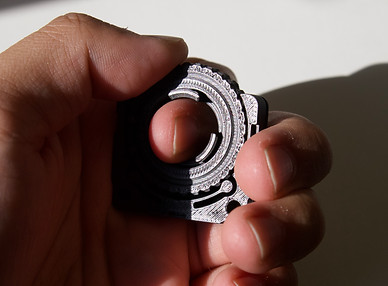
Another design I looked at was this clicky dial, as I have experimented with different 3D models I looked at this model to see how its simple but compact design was able to communicate strong feedback and satisfying response to the user. By utilising 2 FPP and their ability to not flex to where they will get worn out easily, through perfect tolerance and design understanding they are able to produce a satisfying and strong feedback to the user through this design. Simple design plays a big part in not only designing for mechanics but also in being able to utilise them in the desired context, for example as my focus currently is by looking at the interactions found in a steering wheel this mechaism needs to be small enough to fit within this space and though a bit large this design can be utilised there with the right changes. As well as understanding how to play to the strengths of my materials I believe I can get more out of this design than originally intended, by using metal, minimising and perfecting the wheel design there are opportunities to build’s upon an already good design.

Week 10 - Project Positioning and Ethics
Discussion with Dan Scudder and Practice questioning ethics around AI usage

Talk with Dan Scudder
I had the opportunity to talk to Dan Scudder (the head of industrial design at AUT and a previous lecturer of mine) around the scope of my research and my current practice. Beginning with an explanation into my research question and position of my research i communicated the importance of feedback in relation to driver interaction and how i aim to strengthen this relationship through haptic functions in the interior car space, explaining how my practice aims to do this by basing my proof of concept artefact through the interaction between driver and the steering wheel, a key interaction between driver and car with lots of opportunities for feedback.
Keywords and Terminology
Dan encouraged me to narrow my research, being more specific with my research will allow me to deepen my understanding and doing so through find the correct terminology and keywords that represent my research better. Words like haptic and feedback as well as how I talk about AI and autonomous driving will be better communicated with a refined terminology. As well as understanding my contexts better, looking into technological integration in automotive design such as ‘drive by wire’ as examples of technology and its influence on car design.
Positioning
When reflecting on cars of today Dan looked and questioned how technology has influenced car design, how cars have become “too perfect” and how because of the reliance of technology it has allowed cars to work too well, eliminating the things of the outside world and how that removes any feedback to the driver, in doing so automotive designers have led drivers to “lose the ability to understand whats going on”. as cars become more reliant on technology and have become so efficient in smooth driving experiences, designers have lost the ability to communicate the things happening outside of the car to the driver. Research conducted by car manufacturer Peugeot has shown how dangerous silent vehicles are to both drives and pedestrians, and how feedback is needed to know whats happening outside of the car. Contexts like these are needed to create a strong position of my research and my stance as a designer to consider these problems, into why i see technology being a problem and the importance and need of human interactions within this space.
Building a Scope
By creating a stronger position, my scope of research can be defined. Through focusing and narrowing down these core problems and needs i can define a stronger scope of research that can be answer key elements i am researching for. Human interaction and intervention is that stance I am taking as a designer but how this stance be strengthened through a defined scope. A position discussed was the understanding of how ownership of a vehicle comes with responsibility, and how does technology take control of this ownership and and how, through technology, does technology take away our responsibility to be stewards of safe driving standards. My scope needs to look at the relationship not only with drivers and their vehicles but also with Owners and their role on society as responsible stewards who maintain a standard of safety through ownership. My scope of research needs to look at drivers, as owners as the fundamental touch point for where my research needs to be conducted from. Understanding my stakeholders better can begin my research with more boundaries and parameters to achieve more specific objectives will assist in making my research narrow and more precise, to expand on these considerations than exploring other opportunities.
Framing the Problem
From positioning myself as a designer and building a scope, i can strengthen my research by framing my problem more cohesively. Why AI? what is the need for autonomous driving? What are the things AI is doing that is taking away our feedback to respond to the things happening outside of the car? is it making drivers less aware? Why does autonomous driving need to align with a quiet experience? These are questions more focused and directed at a specific problem which is the over reliance of AI and the dependance of drivers being eliminated in favour of technological reliance. Through understanding my problem better i can communicate and build a stance that can begin answering these assumptions and issues.
Research Through Design
Our discussion moved towards my practice and how i looked to understand my context better by understanding of mechanisms and opportunities to understand haptics by designing a dial and breaking down the things that make it function. Dan described my practice as “Research through design”, a design research technique that looks to understand through making. Through my experimentation in week 7 Dan reflected how people perceive interactions, looking at the quality of interactions in car design in reference to my practice. My dial for instance was a good interpretation of understanding mechanisms and how it works but as an artefact can be continually developed to understand how tolerances, haptic feedback and speed can contribute to a satisfying interaction which thus communicates an assurance of quality and how this can communicate a better response from the user. Dan recommended me to look into solid works, to build interactions that can be more easily altered to fine-tune interactions, and testing tolerances to create prototypes and artefacts that communicate these design properties that communicate feedback through the quality of products, these differences can make the difference in how haptics can be perceived. My practice also looks to “overcome complexity” in mechanisms, seeking to gain understanding over why things work the way they do to inform design decisions.
Ideation and Use of Ai
Reflection on Practice


My practice this week was less than I had wanted to make but allowed me to think critically about my position and my intention to design in this space. I looked to design more into the context of my current scope, looking at how the steering wheel could be imagined and how it can interactions and buttons are able to be incorporated into the design of it. I looked to do this through sketching and by trying and experimenting with AI rendering in Vizcom, an image manipulation website that uses prompts to take a sketch into a quick render that can put my practice more into renders faster for faster iterations and ideations. Through this practice I found that I thrived better on rough ideation, as seen in earlier practice I liked how I am able to take rough ideas and perfect them, to take ti one step at a time to take into consideration key features and changes and take a slower more holistic approach to design rather than making AI do it for me. AI also has the tendency to takes things literally, not being able to adapt or envision what I am looking for with my designs and intentions behind each little component of the design and process.
After careful reflection I considered what this weeks practice really meant in the scope of my project, should I be using AI as a tool when my position is against AI? Although I am looking at it from a different context the question still begs if this contradicts the position of my practice. As I look to design for people and for humans, designing with the intention of bringing back the human connection with the drive of the car should I be designing this as a human or as an AI? Should this car of the future be made with the hands of AI and the look and feel and have the characteristics of how AI sees the future of automobile design or take the position as a human and as a designer to make those decisions to retain and hold on to the human involvement and importance in driving a car through design. This question of ethics and what is right and wrong in position to my project has led me to think about how am I designing for people and more importantly for drivers to retain control over the continual integration of AI within this space. As this was a good practice to see the benefits of AI and how it can be used for quick ideation and rendering to bring ideas to life I shouldn’t be relying on it, to still look to use methods and making that reflects how designers and car manufacturers of the past have designed cars, with heart, with imperfection but importantly with a stronger connection to the reason for the drive and the reason drivers should be engaged not disengaged with the drive.


Week 11 - Connection through Design and Position of Practice
Isolating project needs and understanding behaviour of handle design

Talk with Eujeen
I had the opportunity to talk to a potential supervisor this week in Dr. Eujeen Hwang, an Industrial designer who I have had the privilege of working with in my undergrad as my lecturer. Our conversation was focused on gaining clarity on my research project as there was fear that it was still too broad and not clear enough contextually. There was a fear I was trying to solve too many things at once as I was trying to choose a target audience as well as how I would achieve it. For example my project looked like this: I was looking at manufacturers and how they should design interiors but also at drivers and their responsibility in driving, and how this should be done through emotional design and that can be extracted with the use of haptic design and through it it can invoke a stronger connection of the drive to drivers. Basically I was trying to solve too many problems but also not identifying what is wrong with this current evolution of cars.
Something that will be good will be to answer these following questions:
-
What am I trying to solve?
-
Why is this important to solve?
-
Where in the car is the problem lying?
-
For what time period is this car for?
-
Who am I trying to solve it for?
As I want to position my work in:
-
Autonomous Driving
-
The Need For Human Interference,
-
A Call For The Return Of Haptic And Physical Interactions In The Car,
-
The Responsibility Of Drivers And Their Ownership As Car Owners And Stewards Of Road Safety,
-
How Design Can Involve Engagement With The Driver And The Vehicle.
I need to be able to isolate and view some of these problems as contexts, rather than being the core identity of the project. I need to work on this better to be able to communicate the importance of my project and its importance to car design as a whole. I have been able to do that through Creative Research Practice Design as Jennifer has been able to help me break down my project into its key themes, ideas and contexts and see how my project may not be all of those things but rather how they are being used to position my work against all of these things in the world currently.


As well as challenging my assumptions, Eujeen questioned how my stance is currently formed and truthfully it was from assumptions and less on the facts. She encouraged me to look at this through a critical and analytical lens, not to see things as how I perceive them but what the facts say. When dealing with safety and with driver interaction through human centred design, it is important for me to consider not only my assumptions and thoughts but the actual facts that researchers have been able to identify. Through this I can gain a perspective on what the need is out there rather than of my assumptions on the matter. Looking at Internet of Things (IoT), Human Computer Interaction (HCI) and how people respond to this through the lens of emotional design can I gain an understanding to the problems and how I am able to design properly into this space. My practice should be a reflection on facts not assumptions and how interaction can lead to greater connection between driver and car and as my research sits within the framework of autonomous driving and machine learning I must look at things such as IoT and HCI to understand humans, the relationship with technology, and identify how my research falls into that scope.
Eujeen helped me to see that there was a lack of cohesion and understanding in my project, though I have alot of good core ideas they haven’t been fully explored and haven’t been fully looked at and because of this I have a struggle in grasping the true essence and true understanding of what my project is trying to solve. There are alot of themes that I haven’t explored as I have been looking at them as one problem rather than being able to isolate them and look at them individually to solve the many components of my project scope. Something that will be good will be to answer these following questions:
Reflection on Practice
Taking the talk and bringing it into my practice I look to continue exploring how the design of interactions within the interior car space can influence engagement and doing so while looking at the steering wheel and how it can be further influenced through its design. I looked at this as an opportunity to go back to my DP1 practice, looking back at how current designers put themselves into their work by the methods they implore and how they gain an understanding through empathy through design methods. I looked at the design of the steering handles, how the shaping can be influence the comfort and ease of use through the designs of the handles to gain a deeper sense of emotional connection to the product and through this if I can gain gain empathy to driver through ergonomics and comfort.
Handle Making + New Methods
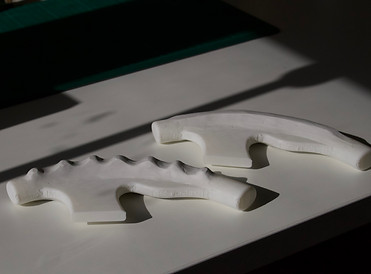
I looked to combine a few methods for my making this week with 3D modelling, 3D scanning and the use of model making with clay/plasticine to look at ergonomics and affordance. When talking En Torng (a wetlabs technicians) she suggested starting simple with a base, 3D modelled of where my starting point for my handles should be. From there I can use a softer material like plasticine to shape the ergonomics of the handles, looking at how the different thicknesses or details can help make the grips and steerings more comfortable. Through this combination of digital and physical model making I can then take it and 3D Scan the final products to be able to print out a physical model of the handle I have designed. Through this I can design and make with the combination of digital and physical mediums, looking towards a balance in model making and human uniqueness through imperfections. 3D scanning was a new technique I hadn’t tried before, though sit took some getting used to it was very beneficial for my work as the process was easier than expected but made for a very strong design that even helped to ‘perfect’ the design through its ability to smooth and eliminate imperfections in the design without drastically getting rid of the forms created. I was able to print handles that were more comfortable than my inital base model but through it I could get a closer connection as it fit more perfectly to my hands and thus a greater physical and tactile connection.



Designing for all People
What I discovered throughout this process was not only the process it takes to create more ergonomic parts but also how the design can have an influence based on who I am designing it for. As I was the designer I was looking at the interaction based on the scale of my hands, how it feels and how the design decisions I was imploring had an effect on the final outcome. However when taking the same product and giving it to my classmate she felt as the handle felt bigger for her, not accomodating to her smaller hand size and thus resulting in a grip less accustomed to her. When designing for people I should consider if I am designing for all people for for just one person, consideration into this design choice will have an influence in how my product will be perceived for the intended drivers as well as if I want to design for all people how can my design be accomodating or customisable to fit the needs of many different drivers?
Traditional Making Techniques
Another discovery throughout this making this week was how I can utilise different processes outside of CAD and digital modelling - the power of model making. As I had explored earlier in DP1 there are many traditional ways to design that will be more authentic and in ways more human that CAD and digital modelling cannot do. By using modeling with plastering (plasticine over clay as plasticine is forever foldable and won’t dry/crack making it ideal for iterations and model making) and putting it into context of handles and ergonomics, I can design and shape things more organic and thus more intentional in its relationship with people and the interactions seen in the car today. As automotive design leans further and further into automotive and designing for the passenger rater than the driver it is important to see how design decisions like this can help engage the driver through design and use of organic ergonomics and affordance to communicate the need for touch. Rather than being geometric, perfect and technical I can lean into the authentic, handmade and imperfectness of design to draw an emotional connection between driver and vehicle through subtle design decisions.


Week 12 - Summative Presentation
addressing project needs and initial ideations

Week 12 Formative Presentation
Abstract
We live in an age of rapid expansion and evolution, especially in the world of technology as new machines and tools have changed the way we live and work in the world. Artificial Intelligence (AI) is the most recent of these advancements and has been quickly adopted and implemented into many industries worldwide, however the most prominent and heavily experimented use of AI is its integration into automotive design. AI within this space looks to the future, to a car without a driver, for passengers to put their faith into a system that will get them from place to place safely, but should we as designers allow this to be our future?. Should our future force drivers to give up our control and autonomy to AI?
The need for drivers and responsibility they have has left a void in responsible driving, and with automobiles becoming more and more perfect we are beginning to lose the essence of why driving is an embodied experience, to embody the driver through a participatory experience not an observant one. How does embodying the driving experience deepen the relationship between driver and car?
I look to understand the importance and need for human interaction when driving, to understand the importance of the driver and vehicle relationship in the driving experience as an emotional connection. By utilising Haptic Feedback and its ability to communicate through the sense of touch (through vibrations, behaviour of mechanisms and force-feedback interactions and functions) I aim to understand How can we design the behaviour of physical, tactile, and force-feedback elements that the driver’s body interacts with so that they support embodied responsibility and engagement when driving.
My practice reflects an understanding of the current interactions of drivers and their environments today, while looking at how physical interactions can elevate this experience beyond moments in time. I look to design and develop haptic interactions through analogue functions through a steering wheel system. Looking to understand and explore how mechanisms directly communicate to the driver and the importance of driver interaction while driving through the exploration of interactions and how design can influence the behaviours of these interactions to communicate a greater response between car and driver. Driving needs to be an embodied experience, with driver and car working together in their responsibility to safe driving, the removal of responsibility by eliminating force-feedback elements and behaviours takes away from the driving experience and puts it into the hands of others.
Feedback on Presentation
Presentation Lecturers: Tammie Leong, Jyoti Kalyanji, Dan Collings
My presentation showed alot of insights into my thinking, my current design decisions and where my position currently is in my practice. I discussed my thinking into where my project scope currently lies, in how I am looking to Embody the Driving Experience, Through the behaviour of tactile interactive functions of Interior car Design, in order To create a safer driving experience. Through this simplification I believe it was a clearer idea of my project niche and where I was intending to design and who it was for. However it was still very broad, as highlighted by the lecturers but with a more clear idea and direction I believe it is more valuable to have this position and foundation rather than moving forward into my thesis without a clear direction in mind, though a good clear problem and review on the matter would be beneficial moving forward I believe that after a semester of confusion and grasping at my project position I believe this is a strong stance to have moving into my project thesis. Dan Collings questioned my need to look deeper into the safety aspect that I am designing for, even though I have a strong stance with AI and the interior design of cars, being able to think about materials and the safety aspects of the car will be critical in supporting this idea of a safer driving environment and how understanding what materials I can use can lead to a greater connection between driver and vehicle, as this connects to emotional design and the perception of how the driver sees the car, something like materials can lead to greater connection that also leans into the tactile and physical interaction between driver and car. When looking into what interactions have to be explored between driver and vehicle I believe it is important to also consider the people I am designing for. As considered in week 11’s blog entry, the need to focus on a particular driver is key for this project in establishing a need for the drivers. Through this I can begin looking into how specific drivers work and how I am able to help cater to the needs of these drivers that I aim to design for. Some drivers need comfort, ease of button use, help navigating etc. understanding their pain points and needs will let me be more specific and look deeper into their needs and be able to design for and accommodate them throughout this design process. There’s alot of conversation around this space and I haven’t decided on a specific area within this space that I want to design in. Being more specific and intentional on the area of focus and my intention to design will help guide areas of my research further along into the thesis and will make my position stronger because of it.
I also need to consider how can haptics provide a better feedback for the users I want to help. How can I use haptics to invoke a greater sense of attention, awareness, and appreciation of the little things that are involved with the drive. Sue Gallagher highlighted that haptics work as a momentary interaction, an action in a moment not fully involved in the engagement of the drive. As I intend to use haptics to create connection between the driver and the vehicle how can haptics be used beyond this momentary interaction, can they leave a lasting impression that will influence the drive or do I need to look at other interactions and manipulate those that interact fully with the drive, such as vibrations, g-forces etc. this begs the question on How can I engage with the drive not just the moments within it?
Tammie Leong, an interaction designer, spoke on her experience when designing racing games, in how to immerse the driver fully into the exprerience of driving as well as how can they simulate the most realistic experience for simulation drivers and replicate the drive to provide accurate data, information and feedback to the simulation driver. One of her insights was that the design of the interface can take away from the driving experience, and thus affects the drivers sense of ability and their skills. She found that the most important part of immersing the driver in this space was how vibrations and feedback were communicated through the steering wheel, through this they were able to grow an engagement with the driver to provide the most realistic and most engaging experience for drivers. Game design focuses fully on the driver, how they design for the people behind the wheel as they are the ones who are engaged with the drive. Through simulation of the vibration and the tension that comes from steering they found that it was this interaction that is most important for drivers. Autonomous, electric and Smart Cars take away that experience from the drivers. The focus on haptics revolved around how the Vibration and tension informed the driver to react. However this is also in context to racing drivers and their situations, not to road drivers. As I consider may audience and the drivers I want to be designing for, I might need to look deeper at who I want to design for, as said earlier to engage fully with their needs and expectations of driving, especially as I look to design fully for the driver, not any one else within the car.
Reflection on Practice
When looking back across the paper I realise the importance of what I am doing and designing for. Although it seems like my practice is disjointed I believe it lead me to understand the inner-workings and requirements of how and what I am designing for. When looking to bring back tactile interactions and physical it was important to see how they were made, what makes them work best, how little variances such as tolerance and tension played a big part in how feedback can be communicated through the design of an artefact. These little behaviours can be greatly manipulated through design as well as the materials used and understanding these things can help elevate the interaction vastly. And understanding how myself and users interact with these things has had great insight into the assumptions I am making, how I need to continually ground my practice to align with the interaction and feedback of the tactile interactions. The need to understand these things have served a great understanding into the needs of the driver and through the intention of design through research I have gained valuable insights into how to make in relation to driver needs and growing a deeper, emotional connection between driver and interaction. There is always more that can be done, iterations of steering wheels and interior design can come later, but the core practice of me understanding behaviours of objects top communicate feedback to the user is more necessary at this point of the project.
Moving into my research thesis I look to put these user interactions and relationships into context, being able to create an embodied experience through designing interactions through object interactions comes through iterations and making in context of my intended drivers and their audience. In saying this I need to decide my users, understand their needs and being able to take these needs and create a better interaction through design. When putting my designs into context I look to design further into user testing, being able to test interactions and feedback to a greater capacity that involves human centred design by gaining insight from users and seeing if my practice and making aligns with the needs of my intended users and audience. Utilising user testing techniques like testing and wizard of oz techniques I look to gain a better connection between drivers and their bodily responses to driving to a greater scale. I also aim to through my thesis position my practice that identifies a smaller problem. As highlighted by Eujeen the need to solve all of the things I want to do is a bit unreasonable, being able to take my project scope and continually define and get smaller and solve a very core pain point and problem can help elevate my work than if I were to try solve all of the problems I have identified, understanding that this project can only be done in the time span of a year, I need to be realistic but also ambitious in my work and practice.